Crazy Rich: Literally
On Money, Transhumanism, and the Brain Damage of Having Too Much
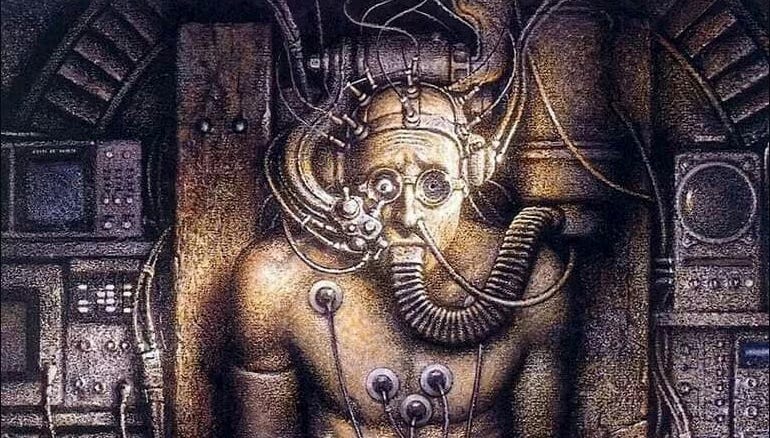
Bryan Johnson is fifty years old, though he claims his biological age is somewhere in the thirties, and he has the complexion of something that feeds at night. He wakes at five in the morning. He ingests dozens of supplements. He monitors his heartbeat with the vigilance of a paranoiac watching for assassins. He has transfused blood from his own teenage son into his veins, a procedure so grotesquely vampiric that Bram Stoker would have blushed to invent it. He spends two million dollars a year on this regimen, and for what? To live forever, he says. To defeat death itself.
If you appreciate my articles, please consider giving them a like. It’s a simple gesture that doesn’t cost you anything, but it goes a long way in promoting this post, combating censorship, and fighting the issues that you are apparently not a big fan of.
And the tragedy—or perhaps the comedy, depending on your tolerance for the absurd—is that he looks worse now than when he started. He has become, through sheer force of capital and obsession, a creature that resembles nothing so much as the undead he is so desperate not to join.
But Bryan Johnson is not an aberration. He is a symptom. He is what happens when a human being accumulates more wealth than the brain was ever designed to process, when the ancient circuitry of survival and status gets so thoroughly overloaded that it begins to malfunction in spectacular and visible ways. He is, in other words, exactly what we should expect from a civilization that has made the accumulation of capital its highest virtue and its organizing principle. And if you want to understand how we got here—how we arrived at a moment in history where grown men drink their children’s blood and dig bunkers in Hawaii and whisper about Satan in secret societies—you have to go back. Way back.
Bronze began its career in human affairs as a weapon. This is important. It was not invented to make jewelry or to decorate temples or to serve as a medium of exchange. It was invented to kill people. The first bronze objects were swords and spearheads and arrowheads, tools for the projection of violence and the consolidation of power. The man with the bronze sword could take what he wanted from the man with the stone club, and so bronze became synonymous with dominance. But here is the thing about power: it gets bored.
Once you have conquered your enemies and secured your territory and established yourself as the undisputed ruler of your little corner of the world, what do you do with all that bronze? You start making pretty things. You make jewelry. You make elaborate vessels for your wine. You make decorative objects that serve no purpose except to announce to everyone who sees them that you are the sort of person who can afford to waste bronze on frivolity. And because powerful people have nice things, everyone else wants nice things too, and so bronze transforms from a weapon into a status symbol and from a status symbol into a currency.
This transformation took centuries. It happened so slowly that no one living through it could have perceived the change. But the pattern it established—the movement from violence to ornamentation to exchange—would repeat itself again and again throughout human history, with cattle and grain and seashells and gold and, eventually, with little pieces of paper bearing the faces of dead presidents. The lesson, if there is one, is that all money is, at bottom, crystallized power. It is violence made portable and fungible. It is the ability to coerce, abstracted and stored in a form that can be carried in your pocket.
David Graeber, the anthropologist, understood this better than most. In his book on debt, he argued that money as a concept emerged not from barter, as the economists would have you believe, but from situations in which the debt was so profound that it could never be truly repaid. Consider the three primordial debts. The first: blood. If I kill your brother, you will want to kill me, and if you kill me, my family will want to kill you, and the cycle of vengeance will continue until one of our lineages is extinguished. But what if, instead, I acknowledge that I have created a debt that can never be settled, and I offer you something valuable—gold, perhaps, or cattle, or bronze—as a token of that acknowledgment? The violence stops, but the debt remains, transmuted into wealth.
The second primordial debt: marriage. When a woman leaves her family to join yours, something irreplaceable has been lost. A daughter, a sister, a source of labor and love and continuity. And so you give gifts to compensate, not because the gifts are equivalent—nothing could be equivalent—but because the gesture matters. The transaction matters. The acknowledgment of obligation matters.
The third primordial debt, and this is the one that explains the tombs, is the debt we owe to the dead.
When a great leader dies, or a beloved priest, or simply someone who contributed more to the community than could ever be measured or repaid, what do you do? You cannot give them anything they can use. They are dead. They have passed beyond the material realm into whatever comes next, and everyone knows—or at least everyone knew, for most of human history—that you cannot take your possessions with you into the afterlife. And yet the bereaved pile gold into graves. They bury their heroes with jewelry and weapons and food and wine. They construct elaborate tombs, mastabas in Egypt and mausoleums in China and pyramids that scrape the sky, all to honor people who will never see any of it. Why? Because the gesture matters. Because the monument stands as testimony to a debt that can never be discharged. Because the community is saying, with bronze and gold and precious stones, that this person was worth more than we could ever give them, and we will remember them forever.
This is what money was, once. A symbol of the unpayable. A token of acknowledgment. A way of making visible the invisible bonds that held communities together. And then something changed.